World Center for Strategic Studies
From closed analysis to public debate
- MONTH
- YEAR

Europe’s Budget Deadlock: Brussels Faces a €2 Trillion Fight It Cannot Afford to Lose
Europe needs more money for defence, competitiveness and energy security, but its governments cannot agree on who should pay. An IRIS analysis by Pierre Jaillet warns that negotiations over the EU’s 2028–2034 budget are becoming trapped between ambitious European commitments and increasingly constrained national finances. The European Council failed to reach agreement on 15–16 October, despite a reduced €1.825 trillion compromise proposal. With elections approaching in several member states and unanimous approval required, the political window is narrowing. Brussels risks entering a period of mounting geopolitical pressure without the financial agreement needed to sustain its priorities.
The €2 trillion ambition is already shrinking
The European Commission originally proposed a seven-year budget exceeding €2 trillion, equivalent to 1.26% of EU gross national income.
Ireland's Council presidency responded with a compromise of €1.825 trillion, seeking to reconcile higher spending demands with national budget constraints.
But the compromise would protect agricultural and cohesion spending while cutting external assistance by 17%, the European Competitiveness Fund by 10.5% and the Solidarity Fund by 55%.
Jaillet highlights the contradiction: governments want Europe to become more competitive and influential while considering reductions to instruments intended to support those objectives.
The old North–South divide is back
Germany, the Netherlands, Austria, Sweden and Finland favour restraining the EU budget and financing new priorities by reallocating existing expenditure.
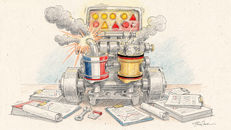
France, Italy, Spain and Poland support a more ambitious European financial role while protecting agricultural subsidies and regional development funds.
Both positions reflect genuine constraints.
Net contributors face domestic pressure to control spending, while countries defending cohesion and agricultural programmes argue that these policies support economic convergence and political stability.
The dispute is not simply about the budget's size. It concerns what kind of Union governments are willing to finance.
Brussels is counting on uncertain revenue
The Commission wants new EU revenue sources to reduce reliance on national contributions.
These include proceeds from carbon-market mechanisms and a proposed levy on multinational companies.
But expected revenue is uncertain. Carbon-market receipts depend on allowance prices and auction volumes, while the corporate levy could generate distortions and opportunities for avoidance.
The European Court of Auditors estimates that the share of financing supplied through national contributions could fall from 67% to 55% by 2028.
Sceptical governments remain unconvinced that the new system will deliver those savings.
Pandemic debt is coming due
The next budget faces an additional financial burden.
Repayment of borrowing under NextGenerationEU is expected to cost approximately €25 billion annually from 2028.
This reduces the resources available for new European priorities.
Jaillet stresses that the previous seven-year budget cannot be compared directly with the new proposal without accounting for the €807 billion recovery facility added during the pandemic.
Once that extraordinary financing is included, the apparent expansion of EU spending looks considerably less dramatic.
France's contribution figures are misleading
The French political debate provides a revealing example of how budget figures can be used selectively.
France contributed €25 billion to the EU budget in 2025, but after deducting EU payments received, its net contribution was €9.5 billion – just 0.31% of GDP.
Including recovery-fund transfers changes the picture further.
France received €34 billion through the Recovery and Resilience Facility between 2021 and 2025. Across that period, its overall balance with the EU was positive by €1.8 billion.
Germany, by contrast, recorded a net contribution approaching €50 billion.
For Jaillet, focusing only on gross payments exaggerates the burden of European membership.
French politics could complicate the deal
Ahead of France's 2027 presidential election, Marine Le Pen has proposed reducing France's EU contribution by €11 billion, while Jean-Luc Mélenchon has advocated a €5.6 billion reduction.
Jaillet argues that such demands offer limited fiscal relief compared with France's wider budget problems.
More importantly, national governments cannot unilaterally reduce their EU contributions without legal and financial consequences.
Any negotiated rebate would require unanimous agreement, making substantial concessions politically difficult.
The author warns that treating EU contributions purely as money lost ignores the economic benefits of the single market and shared investment.
Europe's spending benefits cross borders
Jaillet challenges the assumption that every country should recover exactly what it pays into the EU budget.
Cohesion spending supports poorer regions but also benefits wealthier economies through trade, investment and stronger demand.
The wider economic gains associated with recovery spending in southern and eastern Europe have been estimated at €40 billion for Germany and €18 billion for France.
These indirect benefits rarely appear in political arguments over national contributions.
The danger is that governments focus on immediate accounting balances while overlooking the broader economic returns from European integration.
The warning sign: National budget battles threaten Europe's collective ambitions
The European Council has asked Antonio Costa to continue negotiations, with an extraordinary meeting planned for late November and hopes of securing agreement before the end of 2026.
But elections scheduled in France, Italy, Poland and Greece in 2027 could make compromise increasingly difficult.
Jaillet's central argument is that the EU cannot simultaneously defend agricultural and regional spending, expand investment in future industries, repay common debt and strengthen strategic autonomy without agreeing on credible financing.
Europe's governments must decide whether they are prepared to fund the collective ambitions they repeatedly announce. Otherwise, the next budget risks becoming a contest over national contributions rather than a financial strategy for a continent facing growing pressure from the United States and China.