
World Center for Strategic Studies
From closed analysis to public debate

- MONTH
- YEAR

Europe’s Climate Target Survives – But Brussels Is Weakening the Rules Behind It
Europe has committed to cutting greenhouse gas emissions by 90 per cent by 2040, but the political compromises needed to secure that target are creating new uncertainties. An SWP analysis warns that Brussels is moving towards a more flexible climate system in which foreign carbon credits, carbon removal technologies and weaker national obligations could replace some domestic emissions reductions. The EU remains more ambitious than other major industrialised economies, yet pressure from struggling industries and divided governments is changing how its climate commitments will be enforced. The danger is that Europe preserves an impressive headline target while making responsibility for achieving it increasingly difficult to establish.
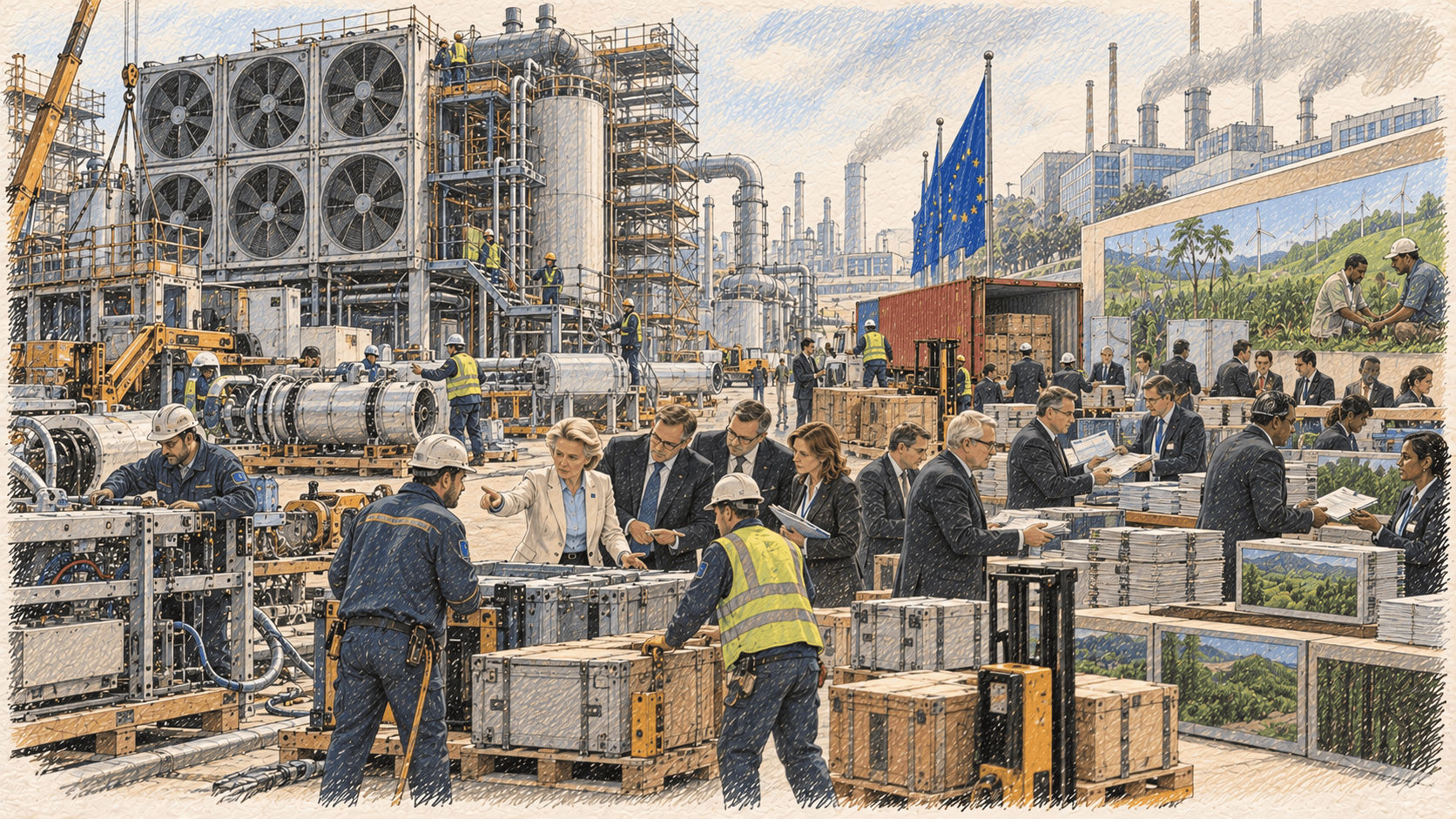
The 90 per cent target comes with escape routes
The EU's 2040 climate target represents a major commitment despite mounting economic and geopolitical pressure to scale back environmental ambitions.
But securing political agreement required significant concessions.
From 2036, emissions reductions financed through projects outside Europe may count towards the target, up to a limit equivalent to 5 per cent of the EU's 1990 net emissions.
The framework also removes previous limits on how much domestic carbon dioxide removal can contribute.
SWP argues that these changes mark a departure from the principle that European emissions targets should be achieved through domestic action.
Europe's carbon market faces an industrial backlash
The EU Emissions Trading System has been central to European climate policy since 2005.
It covers approximately 40 per cent of EU greenhouse gas emissions, including electricity generation, industry, aviation and maritime transport.
But rising production costs have intensified demands for relief.
Scandinavian governments favour maintaining strong carbon-price incentives, while energy-intensive industries and several Eastern European countries want looser requirements.
Germany supports preserving the system while introducing greater flexibility.
The Commission's proposed reforms would slow reductions in available allowances, extend free allocations for internationally exposed industries and redirect more carbon-market revenue towards industrial decarbonisation.
Foreign carbon credits could reopen an old problem
Allowing international carbon credits introduces a major change in European climate policy.
Brussels hopes to finance emissions reductions abroad while easing the burden on European companies.
But earlier international credit schemes suffered from questionable project quality and unreliable accounting.
SWP warns that the new system's credibility will depend on rules that have not yet been finalised.
From 2036, the Commission's ETS proposal could accommodate up to 260 million tonnes of additional CO₂ emissions covered by international credits.
Without rigorous verification, Europe risks paying for reductions that do not deliver the expected climate benefits.
Carbon removal becomes a bigger gamble
The EU increasingly relies on technologies capable of removing carbon dioxide from the atmosphere.
These include bioenergy with carbon capture and storage and direct air capture with geological storage.
Rather than allowing companies to trade removal credits directly, the Commission proposes centralised purchases financed through additional emissions allowance auctions.
The plan would support purchases equivalent to 250 million tonnes of CO₂ removals between 2031 and 2040.
But these technologies remain expensive and their future capacity uncertain.
SWP also warns that cheaper international emissions-reduction credits could crowd out investment in actual carbon removal unless dedicated requirements are introduced.
Europe's forests are becoming an unreliable safety net
Forests and other land-use activities are expected to absorb substantial quantities of carbon dioxide.
Yet droughts, extreme weather and pest infestations are making these natural carbon sinks less predictable.
The EU's existing 2030 land-use target requires net removals of 310 million tonnes of CO₂ equivalent, but achieving it now appears unlikely.
The revised framework creates another complication: shortfalls in land-use removals should not impose additional obligations on other sectors.
SWP warns that this could encourage governments to accept ambitious forestry targets while allowing other sectors more flexibility, even if those removal targets later prove unattainable.
National responsibility could disappear
One of the biggest unresolved questions concerns binding emissions targets for individual EU countries.
Currently, national targets govern sectors including agriculture, buildings, transport and waste.
But a second emissions trading system covering buildings and road transport is due to begin in 2028, creating overlapping regulatory arrangements.
Brussels must decide what replaces the existing framework after 2030.
Options range from retaining national obligations to merging agricultural and land-use targets or abandoning binding national targets altogether.
The most flexible approach could also make it much harder to determine which governments are responsible when emissions reductions fall short.
Agriculture could reshape the entire system
Agriculture is particularly difficult to decarbonise because livestock and fertiliser use generate methane and nitrous oxide emissions.
These gases have substantially greater warming effects than carbon dioxide.
SWP suggests that merging agricultural emissions obligations with forestry removals may become politically attractive, particularly for countries with large agricultural sectors.
But such an arrangement could weaken pressure for actual emissions reductions if governments rely too heavily on uncertain land-based removals.
The next negotiations will determine whether flexibility improves efficiency or dilutes accountability.
The big warning: Europe's climate ambition needs enforceable rules
SWP does not argue that the EU should abandon its 90 per cent target. Its concern is that political compromises are making the system increasingly complicated before their combined consequences have been properly assessed.
The Commission must clarify the quality and use of international credits, the role of carbon removal and the future of binding national targets.
Otherwise, businesses and governments will face years of uncertainty while Europe's climate commitments become harder to translate into measurable domestic action.
Brussels has protected the headline ambition. The real test is whether it can preserve the credibility of the policies needed to deliver it.