World Center for Strategic Studies
From closed analysis to public debate
- MONTH
- YEAR

Europe’s Competitiveness Crisis: Brussels Is Overlooking the Economic Power of Enlargement
Europe is struggling with weak productivity, an ageing workforce, fragmented markets and growing pressure from the United States and China. Yet one potential source of economic strength remains largely absent from Brussels’ competitiveness agenda – EU enlargement. In a CEPS policy brief, Tinatin Akhvlediani, Pierre-Alexandre Balland and Andrea Renda argue that admitting new members could help Europe expand its industrial base, secure critical resources, attract investment and strengthen technological capabilities. Enlargement is usually presented as a geopolitical necessity, particularly after Russia’s invasion of Ukraine. But the authors warn that treating it mainly as a security project means overlooking its potential to address some of Europe's most persistent economic weaknesses.
Europe's single market is still too fragmented
The EU has a large economy but struggles to turn its size into the industrial scale enjoyed by American and Chinese competitors.
Regulatory barriers, fragmented markets and insufficient cross-border investment prevent European companies from expanding efficiently.
CEPS argues that enlargement could create a larger and more integrated economic area, improving competition, investment opportunities and regulatory predictability.
But simply admitting more countries will not deliver these benefits. Candidate economies must be integrated into the single market through credible reforms and functioning institutions.
Europe needs factories closer to home
Recent geopolitical shocks have exposed the vulnerability of European supply chains.
Dependence on distant suppliers creates risks for manufacturers when trade restrictions, transport disruptions or political conflicts interrupt production.
Enlargement could help European companies relocate parts of their supply chains to neighbouring candidate countries.
Such nearshoring would provide access to additional production capacity while keeping more industrial activity within a common regulatory framework.
For candidate countries, it could also generate investment, employment and opportunities to move into higher-value manufacturing.
The labour shortage is becoming a structural threat
Europe's shrinking working-age population is putting pressure on businesses and public services.
Candidate countries could expand the available workforce and provide skills needed by European employers.
But CEPS stresses that the benefits depend on how labour mobility is managed.
If integration simply encourages qualified workers to leave poorer candidate economies permanently, it could deepen demographic and economic problems in those countries.
Higher productivity, better employment opportunities and stronger domestic investment are therefore essential to making enlargement beneficial on both sides.
The digital economy offers another opportunity
Europe's technological weaknesses are not limited to a shortage of investment.
Its innovation ecosystem remains fragmented, and many promising companies struggle to achieve the scale needed to compete internationally.
CEPS argues that enlargement could bring additional digital talent, research capacity and innovative businesses into European networks.
Closer integration would create opportunities for cross-border technological cooperation and larger markets for digital services.
However, these gains require investment in infrastructure, skills and regulatory alignment rather than assuming that a larger population automatically produces stronger innovation.
Critical minerals could reduce dangerous dependencies
Europe's industrial and energy ambitions depend on reliable access to critical raw materials.
The EU remains exposed to concentrated international supply chains, particularly those involving China.
Candidate countries could contribute additional mineral resources and opportunities to develop European processing and manufacturing capacity.
This would help diversify supplies for industries such as batteries, clean energy technologies and advanced manufacturing.
But resource availability alone is insufficient. Europe would still need investment, infrastructure, environmental safeguards and commercially viable processing facilities.
Poor connectivity is holding the region back
Transport, energy and digital infrastructure remain major obstacles to economic integration.
Weak cross-border connections increase business costs, limit trade and discourage investment.
CEPS identifies better connectivity as a central mechanism through which enlargement could improve competitiveness.
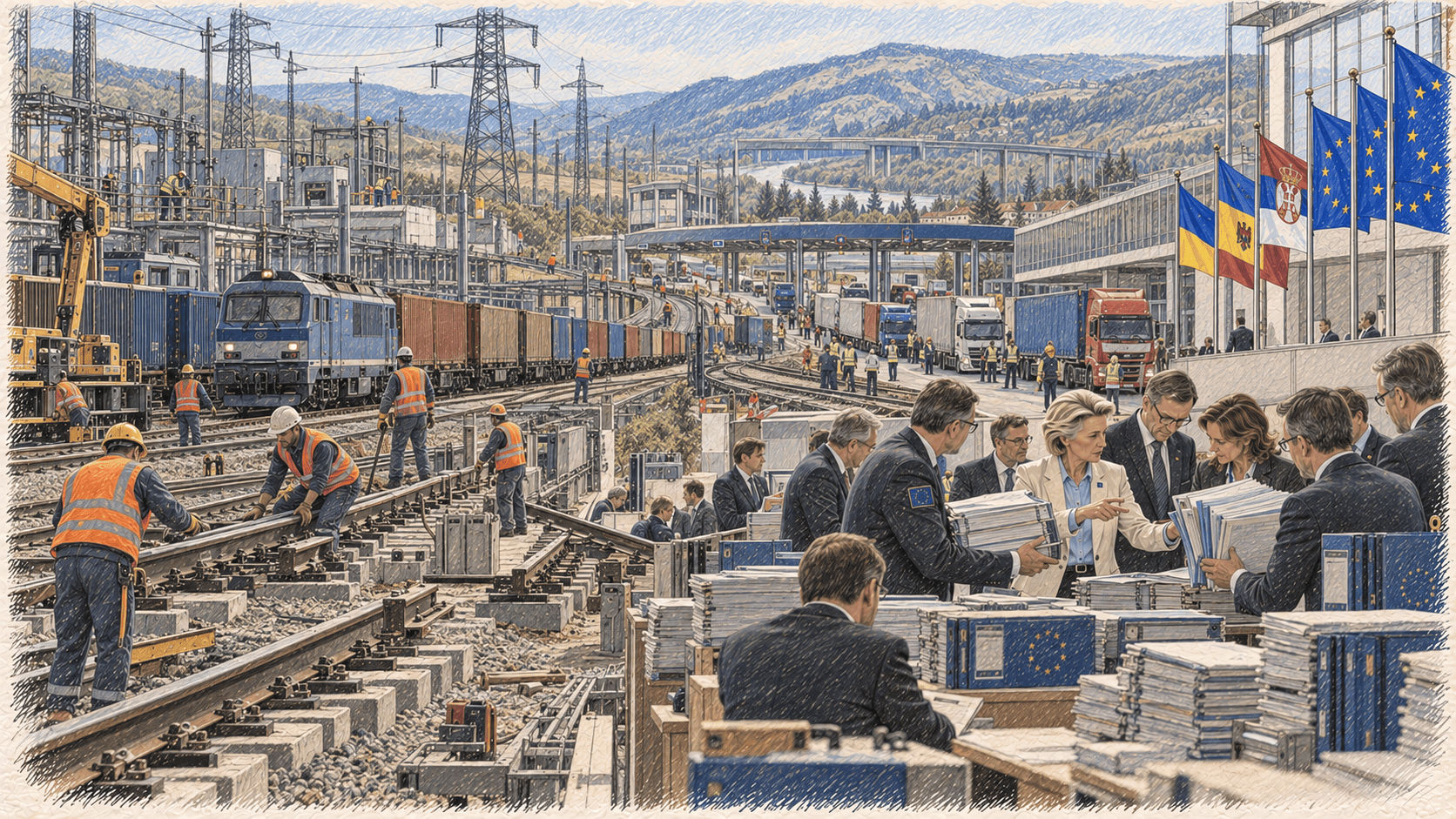
Integrating candidate countries into European transport corridors, energy networks and digital infrastructure would strengthen supply chains while creating larger and more resilient markets.
The benefits would extend beyond future members to companies and consumers throughout the EU.
Security is becoming an economic advantage
The authors also connect competitiveness with geopolitical stability.
Russia's war against Ukraine has demonstrated how insecurity can disrupt investment, energy supplies, transport and production.
Closer economic integration with candidate countries could strengthen Europe's resilience by expanding trusted supply chains and reducing vulnerabilities in strategically important sectors.
Enlargement would therefore serve economic and security objectives simultaneously.
But the potential benefits depend on credible institutions, political stability and sustained reforms in candidate countries.
Brussels cannot afford another slow-motion accession process
CEPS argues that Europe should stop treating enlargement as a distant diplomatic reward and begin integrating candidate economies before full membership.
The authors favour a merit-based approach in which progress towards EU standards produces tangible economic benefits.
That means prioritising single-market integration, investment, infrastructure development and stronger industrial connections.
The objective is not to abandon accession requirements but to ensure that the economic advantages of enlargement begin materialising earlier.
The reality check: Enlargement could strengthen Europe's struggling economy
CEPS presents enlargement as a potential response to several weaknesses simultaneously – limited industrial scale, labour shortages, technological fragmentation, supply-chain dependence and inadequate connectivity.
But none of these gains is automatic. Poorly managed integration could intensify brain drain, leave infrastructure gaps unresolved and create new economic disparities.
The authors' central message is that Brussels should make enlargement part of its long-term competitiveness strategy rather than treating it as a separate geopolitical project.
Europe is searching for new sources of growth and resilience. Its future members could provide part of the answer – if the EU can turn accession promises into practical economic integration.