World Center for Strategic Studies
From closed analysis to public debate

- MONTH
- YEAR

Europe’s Indo-Pacific Blind Spot: France And Italy Skip The Big Theatre
France and Italy have just staged a show of renewed unity at Antibes, but the IRIS note points to the awkward omission: the Indo-Pacific was missing from the serious agenda. That is not a minor diplomatic gap. It is a warning that two major EU powers are still treating the world’s central strategic arena as secondary business.
The summit produced movement on defence, air defence, civil nuclear energy, space, migration, the Mediterranean and organised crime. Useful, concrete and politically necessary. But while Paris and Rome were tightening their bilateral machinery, the Indo-Pacific – where global trade, naval rivalry, supply chains and technology competition collide – was left outside the room.
Europe says it wants to be geopolitical. Then it forgets the region where geopolitics is being rewritten.
Antibes looked busy – but incomplete
The 36th Franco-Italian summit was designed to show that the Quirinal Treaty is producing results.
After years of tension between Paris and Rome, the meeting showed a more functional relationship. A new defence roadmap for 2026–2031, stronger work on air defence, space, nuclear energy and migration all signalled that the two countries want a sturdier partnership.
But IRIS argues that this practical progress came with a strategic hole. The Indo-Pacific should have been on the table precisely because both countries are now more active there.
The silence was not fatal. It was revealing.
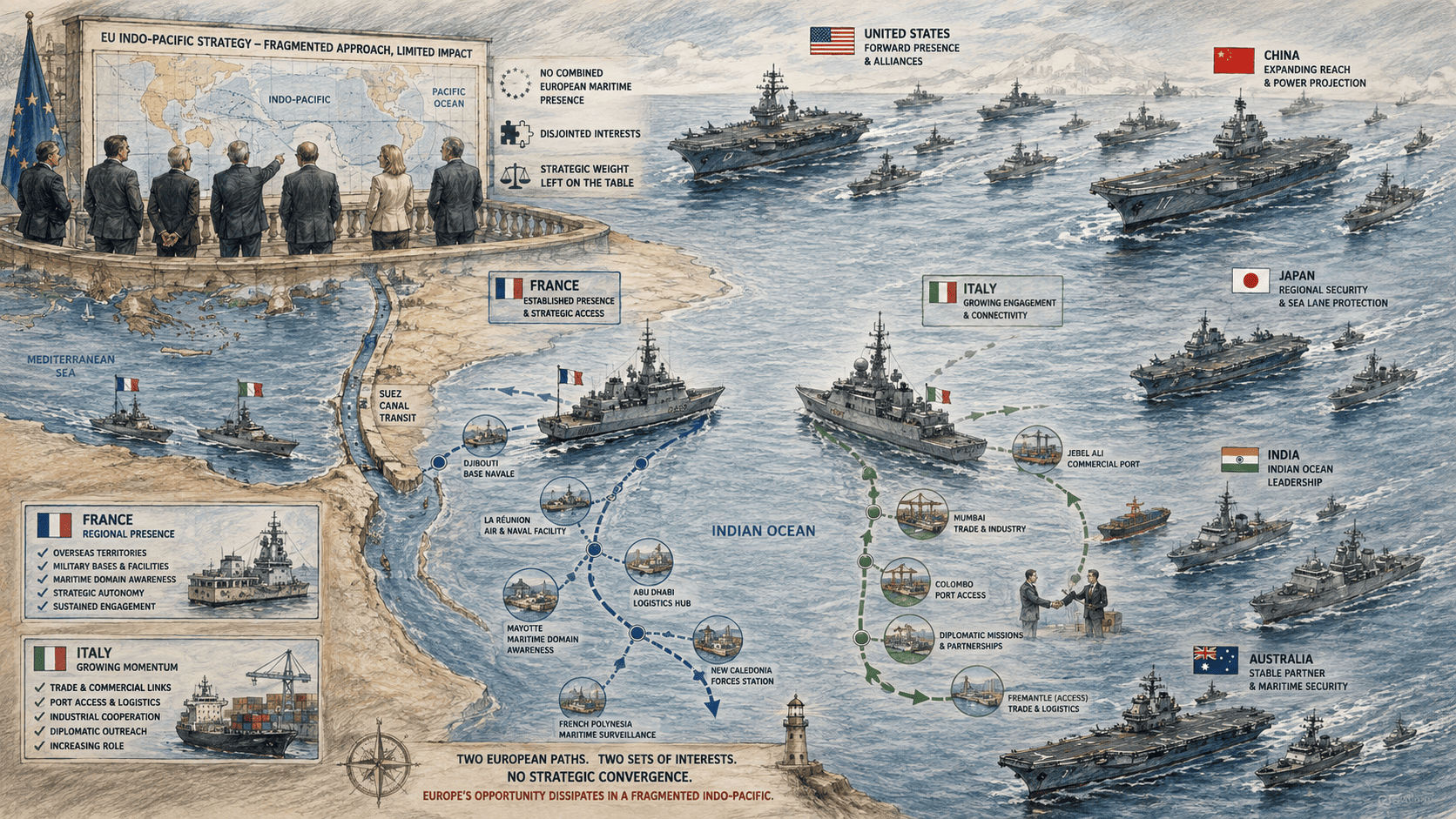
France has presence. Italy has momentum.
France brings something few European states can match: overseas territories, citizens, military forces, maritime zones and diplomatic networks in the Indo-Pacific. Paris sees itself as a resident power, not just a visiting European actor.
Italy’s profile is different but increasingly relevant. Rome is expanding its diplomatic and naval presence and wants to connect the Mediterranean to the Indian Ocean through trade, maritime security and industrial links.
That makes the two countries complementary.
France has the footprint. Italy has industrial and naval ambition. Together, they could give Europe a more credible Indo-Pacific role.
Europe is still too scattered
The EU has had an Indo-Pacific strategy since 2021, but coherence remains weak.
Member states arrive with different priorities, different threat perceptions and different levels of commitment. France has its own doctrine. Italy is building its role. Brussels wants alignment, but often lacks the political muscle to turn national moves into a shared European presence.
A Franco-Italian track could help bridge that gap. It would not replace national strategies or the EU framework. It could connect them.
That is exactly the kind of middle layer Europe often fails to build.
The Mediterranean excuse is not enough
There is an obvious explanation for the omission. Paris and Rome are absorbed by nearby crises: migration, the Mediterranean, Ukraine, the Middle East, transatlantic uncertainty and domestic political pressure.
Those priorities are real. But they do not make the Indo-Pacific optional.
The two theatres are increasingly linked. Maritime routes, energy flows, critical technologies, supply-chain resilience, naval access, port infrastructure and industrial competition all connect the Mediterranean, the Indian Ocean and East Asia.
Ignoring the Indo-Pacific because nearer fires are burning is short-sighted.
China is not waiting
The region is the centre of global economic gravity and one of the main arenas of strategic competition.
China’s rise, US-China rivalry, maritime disputes, technology battles and competition over norms are shaping the future operating environment for European companies, navies and governments.
France and Italy cannot pretend this is remote. Their industries, ports, supply chains, energy security and defence interests are all exposed.
If Europe does not organise itself there, others will set the rules.
Diplomacy needs ships, money and follow-through
The IRIS note is not calling for slogans. It points towards practical cooperation: maritime security, critical technologies, supply chains, energy transition and normative rivalry.
That is where Franco-Italian cooperation could become useful. Joint naval presence, coordinated diplomatic outreach, industrial partnerships and stronger links between the Mediterranean and Indian Ocean could turn rhetoric into policy.
But that requires sustained attention.
Europe has a bad habit of launching strategies, then failing to feed them with resources, habits and institutional follow-through.
The weakness rivals will exploit
The danger is strategic drift.
France may act alone. Italy may advance separately. Brussels may keep producing broad language. Meanwhile, Indo-Pacific partners will look to Washington, Beijing, Tokyo, Canberra, Delhi or Seoul for serious engagement.
That would leave Europe present but not decisive.
A continent that depends on Indo-Pacific trade and supply chains cannot afford to be a spectator in the region’s power politics.
The key point: Europe cannot be global part-time
The IRIS note’s message is sober but sharp. Antibes proved that France and Italy can still build useful bilateral cooperation when they choose to. But the Indo-Pacific omission shows how easily Europe’s long-term strategic agenda is pushed aside by immediate regional pressures.
Paris and Rome have the ingredients for a serious partnership: French presence, Italian industrial and naval capacity, and a shared European interest in open sea routes, resilient supply chains and balanced influence.
Now they need to prove this is more than diplomatic theory.
Europe keeps saying the Indo-Pacific matters.
France and Italy just showed how quickly it can still disappear from the agenda.