World Center for Strategic Studies
From closed analysis to public debate
- MONTH
- YEAR

Greece’s Defence Bet: Europe’s Southern Flank Gets Serious
Greece is no longer just buying French weapons. The ISDP brief argues that Athens is becoming a test case for Europe’s defence pillar – a country using French arms, French political guarantees and deeper industrial cooperation to build deterrence in the Eastern Mediterranean.
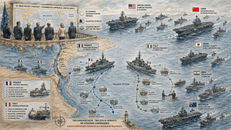
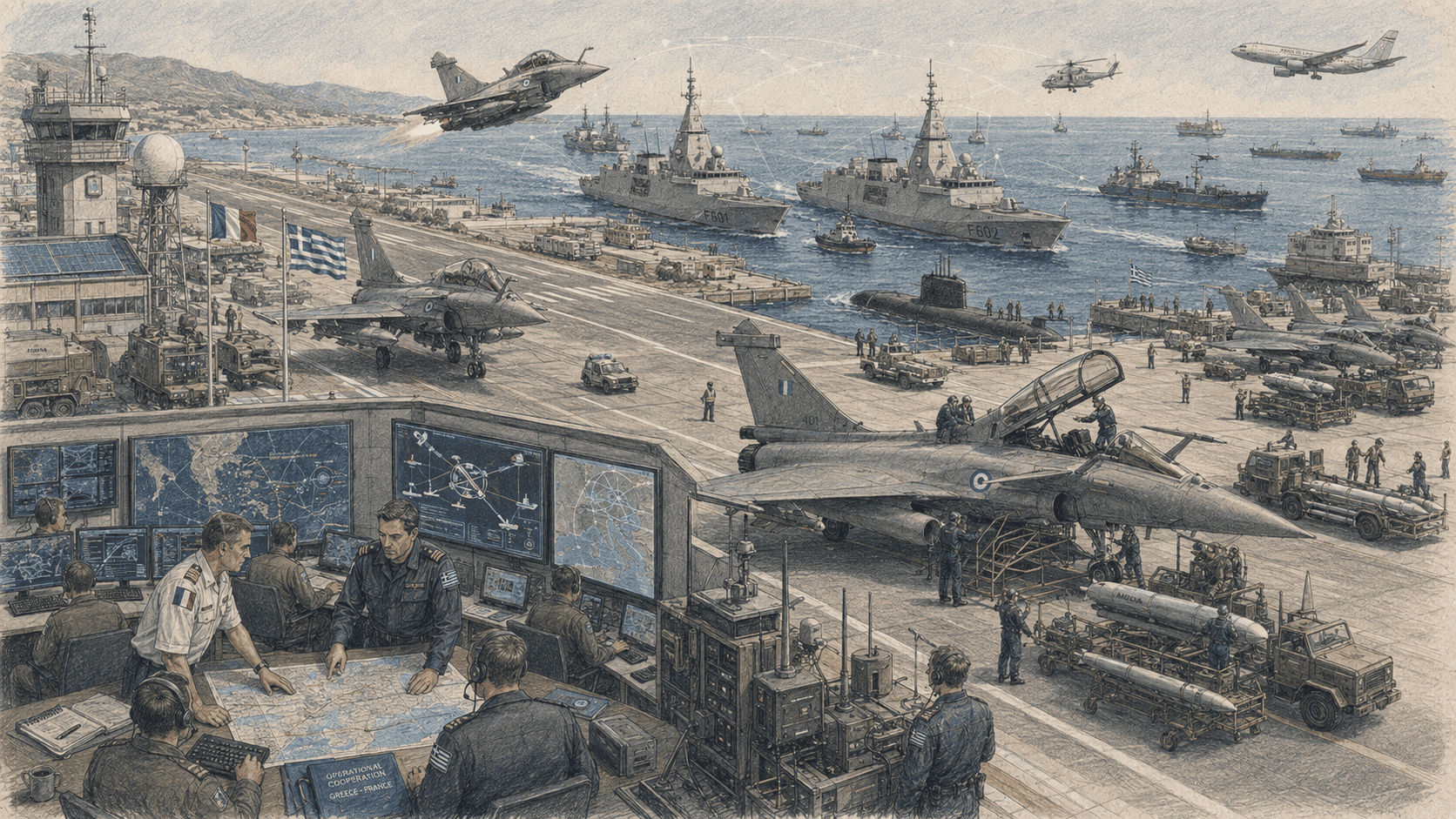
Macron’s April 2026 visit to Athens is treated as more than bilateral theatre. It signals a strategic relationship built around Rafale fighters, FDI HN frigates, possible Blacksword Barracuda submarines, network-centric warfare, long-range strike and a renewed defence pact with a mutual assistance clause.
The message is clear: Europe wants strategic autonomy. Greece and France are trying to turn it into steel, missiles and political commitment.
Athens stops acting small
The brief presents Greece as a frontline actor, not a passive recipient of European security.
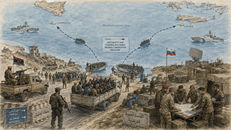
Its location matters. The Eastern Mediterranean is a crowded theatre of energy routes, maritime disputes, Middle Eastern instability, Russian activity, migration pressure and Turkish power. Greece therefore sits at a junction where European, NATO and regional security collide.
That makes Greek defence choices more than national procurement.
They shape whether Europe can act seriously on its own southern flank.
France brings the hard-power brand
France is the natural partner in this argument.
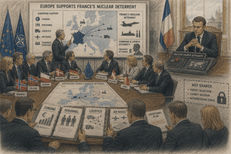
After Brexit, it remains the EU’s only nuclear-armed member state, the only EU country with a permanent UN Security Council seat, a global military footprint and a full-spectrum defence industry. For Greece, that matters because French weapons come with political weight.
Rafales and frigates are not just platforms. They are symbols of a broader strategic alignment with the one EU state that still thinks like a hard-power actor.
The mutual defence clause matters
The renewed Greek-French partnership is built around a mutual defence assistance clause.
ISDP stresses that this is not only legal wording. It is a deterrent message to third parties: Greek security is now more directly tied to French credibility and to Europe’s willingness to respond.
That is important because EU defence language often sounds vague. Here, the promise is meant to look more concrete.
The danger, of course, is that credibility will be judged in a crisis, not at a signing ceremony.
NATO is not being replaced
The brief is careful on one point: this is not presented as an alternative to NATO.
The Greek-French axis is framed as a strengthening of the European pillar inside the Alliance. In other words, Europe should be more capable, more coherent and more credible – but not detached from NATO’s collective defence structure.
That is the balance Europe keeps struggling to strike.
Too much autonomy talk can alarm Atlanticists. Too little autonomy leaves Europe dependent on Washington. Greece and France are trying to show a middle route.
Technology becomes deterrence
The partnership is not limited to buying shiny hardware.
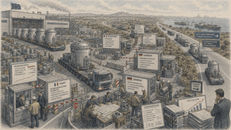
The brief highlights network-centric operations, interoperability, intelligence links, defence innovation, digital ocean technology, professional education, research and industrial cooperation. This is the serious part of the argument: modern deterrence depends on systems that work together, not isolated prestige platforms.
If Greece can integrate aircraft, frigates, submarines, sensors, long-range strike and command networks properly, its deterrent posture becomes much harder to test.
If not, the programme risks becoming another expensive European shopping list.
The Eastern Mediterranean is the stress test
Europe often talks about Russia and the eastern flank. This brief shifts attention south.
The Eastern Mediterranean is where energy security, maritime sovereignty, NATO tensions, Middle East crises and great-power manoeuvring overlap. Greece’s role there is therefore larger than its size suggests.
A stronger Greek-French defence relationship gives Europe a harder edge in a region where instability can quickly spill into EU security.
That is why Athens matters.
The weakness rivals will probe
The risk is the usual European one: ambition without delivery.
Advanced systems need training, maintenance, ammunition, integration, industrial support and money over decades. Strategic partnerships need political continuity. Mutual assistance clauses need credibility when pressure rises.
If Greece and France announce deterrence but fail to sustain the machinery behind it, rivals will notice.
Deterrence is not built by ceremony. It is built by readiness.
The hard lesson: Europe needs pillars that can actually stand
The ISDP brief is ultimately optimistic about Greece’s role. It sees Athens as a key partner in building a stronger European defence pillar, especially in the Eastern Mediterranean.
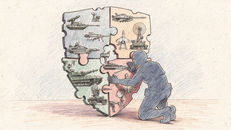
But the bigger European test remains harsh. Strategic autonomy cannot live in speeches about sovereignty. It needs capable forces, trusted partners, industrial depth and political commitments that survive crises.
Greece and France are offering one model.
Now Europe has to prove it can turn that model into real deterrent power – before the next shock reaches its southern flank.