World Center for Strategic Studies
From closed analysis to public debate
- MONTH
- YEAR

Europe’s Open Borders Are Becoming an Economic Liability
One of Europe’s greatest achievements is increasingly being treated as a security problem. Across the Schengen area, governments are reintroducing temporary border controls in response to migration pressures, security concerns and political demands. The Stratfor analysis warns that these measures may look temporary, but their economic consequences could become much harder to reverse.
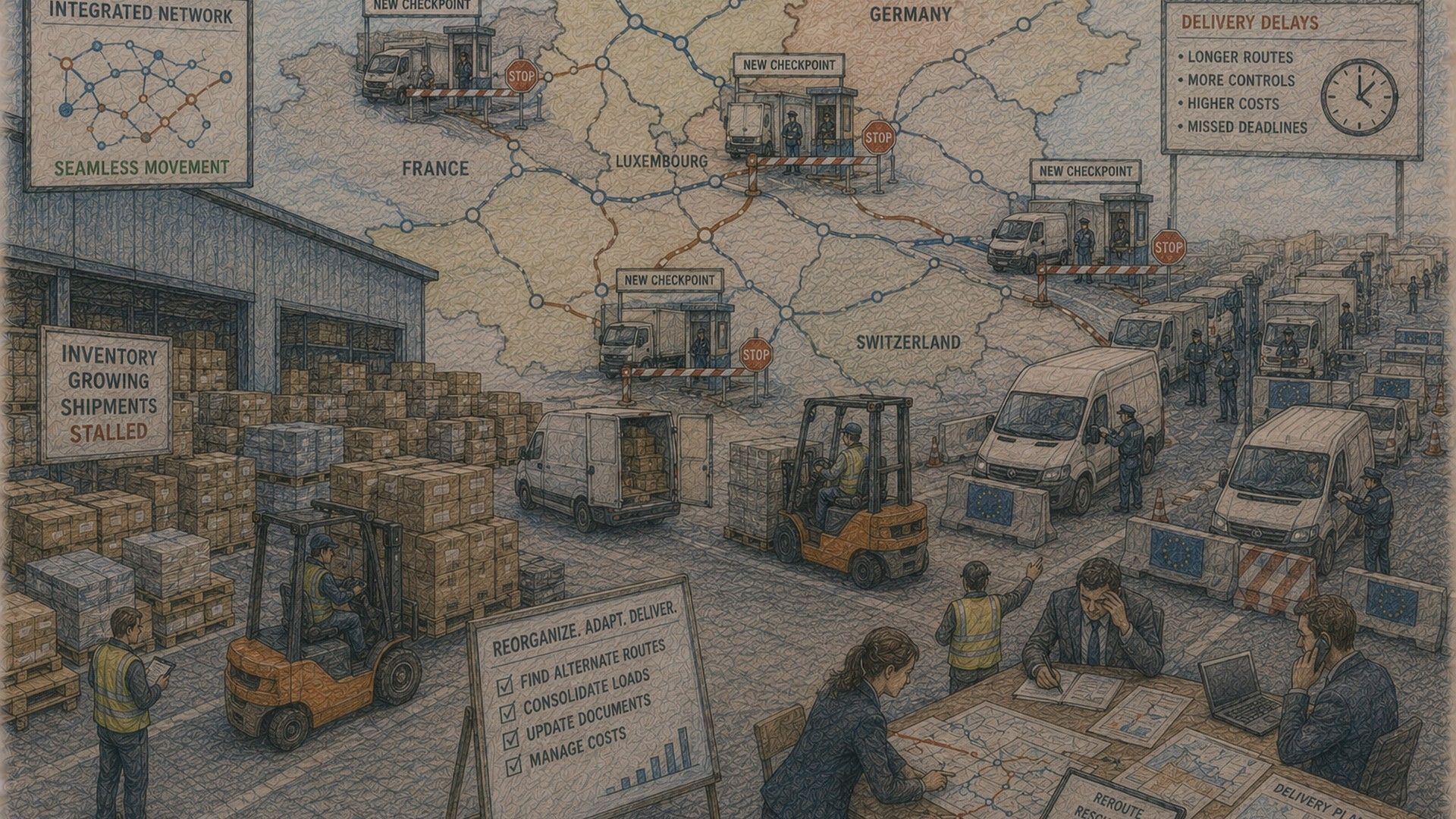
The paper highlights a growing contradiction at the heart of the European project. The EU built its economy around the assumption that goods, workers and services could move freely across borders. Yet as more governments restore checks and inspections, the system that made European supply chains fast and efficient is starting to slow down.
The risk is not dramatic collapse. It is something more corrosive: the gradual erosion of one of Europe’s biggest competitive advantages.
Border checks are back
What was once an exceptional measure is becoming increasingly common. Several Schengen countries have repeatedly extended temporary border controls, often citing migration management, terrorism concerns or public security.
Each individual measure may appear limited. But together they signal a broader shift away from the principle of frictionless movement that underpins the single market.
The longer these controls remain in place, the harder it becomes to treat them as temporary exceptions.
Europe built supply chains around speed
Modern European industry depends on constant cross-border movement. Components can cross several national frontiers before becoming finished products. Manufacturers rely on predictable delivery schedules and tightly coordinated logistics networks.
The Stratfor assessment argues that even modest delays can create significant costs when supply chains operate on just-in-time principles.
What looks like a few extra minutes at a border can translate into higher transport costs, inventory burdens and reduced efficiency across entire industries.
The system works because movement is fast. Slow it down and costs start spreading everywhere.
Security gains come with economic pain
Governments argue that border controls respond to legitimate security concerns. The problem is that economic costs accumulate even when the controls achieve their intended objectives.
Transport operators face longer waiting times. Businesses encounter greater uncertainty. Labour mobility becomes less efficient. Cross-border commerce becomes more complicated.
The trade-off is becoming increasingly visible: more border security often means less economic flexibility.
That creates difficult choices for governments trying to satisfy both economic and political demands.
Europe is fragmenting by increments
One of the most striking themes is how fragmentation often happens gradually rather than through dramatic political decisions.
No country is openly abandoning Schengen. No government is calling for the end of free movement. Yet repeated extensions of temporary controls create a situation where the practical reality starts diverging from the original vision.
The danger lies in accumulation. One checkpoint becomes several. One temporary measure becomes routine. One delay becomes part of the operating environment.
The system weakens without formally changing.
Politics is driving economics
Migration remains a major force behind the trend. Governments facing domestic political pressure increasingly see border controls as visible demonstrations of action and control.
The economic costs are often less immediate and less politically visible than concerns about migration or security. That creates incentives for policymakers to prioritise short-term political gains over long-term economic efficiency.
As public pressure rises, more governments may conclude that tighter borders are politically safer than defending open ones.
This will hit competitiveness
Europe already faces intense pressure from higher energy costs, industrial competition from China and investment attraction efforts in the United States.
Additional friction inside the single market risks making these challenges even harder to manage. Businesses operating across borders could face higher costs just as global competition intensifies.
The irony is striking. Europe spends enormous effort trying to strengthen competitiveness while simultaneously introducing barriers that make economic activity less efficient.
The weakness Europe created itself
Unlike many external threats, this vulnerability is largely self-inflicted. The pressures driving border controls may be real, but the resulting strain on supply chains emerges from political choices made within Europe itself.
The continent's economic strength has long depended on integration, scale and seamless movement. Every new restriction chips away at those advantages.
The process is incremental, but the cumulative impact can be substantial.
The ugly reality: Europe is testing the foundations of its own success
The Stratfor analysis is ultimately about more than border checks. It is about a continent caught between competing priorities that are becoming increasingly difficult to reconcile.
Europe wants open markets, efficient supply chains and economic competitiveness. It also wants stronger migration control and greater security. Maintaining both simultaneously is becoming harder.
The uncomfortable truth is that every new border checkpoint solves one problem while creating another.
And if temporary controls become permanent habits, Europe may discover that the cost is paid not only at the border, but across its entire economy.